
Recapping our table at the AMA Marketing Lab
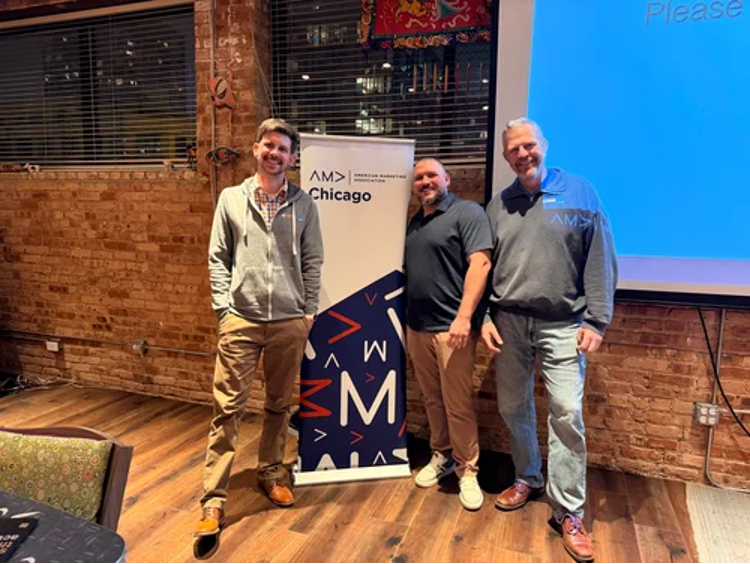
On March 6th we had the chance to attend the AMA Marketing Lab event here in Chicago at Catalyst Ranch, and once the larger group sessions wrapped up, attendees broke off into smaller discussion tables. That’s where the real conversations started.
At our table, Steve Krull and I hosted a session called “SEO Foundations with AI Considerations.” The goal was simple: to help marketers understand how AI search is changing the way people discover brands online and why the fundamentals of SEO still matter.
There’s a lot of noise right now around AI replacing search, killing traffic or completely rewriting the playbook. Our perspective is a bit different. AI visibility isn’t replacing SEO. It’s being built on top of the same foundations that have always helped brands earn trust and authority online.
A Table Full of Different Perspectives
One of the best parts of the AMA Chicago event was the variety of people we had the chance to talk with. Around the table we had folks from healthcare software companies, PR firms, data consulting groups, social media agencies, local contractors, an e-commerce brand and even a matcha startup.
Different industries, different challenges, but the same questions kept coming up.
A few themes surfaced almost immediately.
- There’s a lot of uncertainty about where AI search is going.
Many attendees talked about the unknowns and the possibility of losing organic traffic as AI answers start appearing before traditional search results.
- People are trying to figure out what tactical shifts actually matter.
We heard a lot of questions around things like FAQ content and schema markup, both of which are becoming more relevant. AI systems work to interpret, structure and summarize information from across the web while also responding to long-tail questions within prompts. Keywords are transitioning into conversations.
On top of that, many teams are starting to feel internal pressure from leadership asking questions like: “What are we doing to show up in AI results?” or “Why does our brand appear this way when I ask an AI tool about us?” These types of questions are becoming more common as organizations begin to test their own visibility in AI search experiences.
Marketers are trying to understand how success should be measured moving forward.
Instead of only looking at rankings and traffic, the conversation is starting to include signals like brand mentions, citations in AI responses and how frequently a brand appears in recommendations.
In other words, the question is slowly shifting from “Do we rank?” to “When AI answers questions in our category, are we included?”
The Resource We Shared at the Table
To help guide the discussion, we created a simple one-page (front and back) resource that attendees could take home with them.
The resource focuses on the four core pillars of SEO, but framed through the lens of AI search. These pillars are still the backbone of visibility online:
1. Technical Foundations: AI systems rely on structured, crawlable websites. If search engines struggle to interpret your site, AI systems will, too. Clean HTML, proper canonicalization, schema markup and fast performance all matter.
2. Content and Topical Authority: AI systems tend to synthesize trusted sources rather than simply matching keywords. Brands that clearly demonstrate expertise across a topic area are more likely to be referenced in AI-generated answers.
3. On-Page Clarity: Clear structure, logical headings and well-organized explanations make it easier for AI systems to understand and reuse your content.
4. Off-Page Authority (E-E-A-T*): AI doesn’t just look at your website. It reflects the broader web ecosystem, including backlinks, reviews, expert contributions and brand mentions across other platforms. (*E-E-A-T: Experience, Expertise, Authoritativeness, Trustworthiness.)
The takeaway we kept coming back to during the discussion was that AI visibility is really a trust problem. The brands that are consistently cited or referenced tend to be the ones with strong authority signals across multiple channels.
If you’re interested, view/print the PDF of this resource.
Traditional SEO vs. AI Visibility
Another concept that resonated with the group was the difference between traditional search optimization and what we’re now calling AI visibility.
Historically, SEO success meant earning strong rankings in search engine results pages. But AI platforms like ChatGPT, Gemini, Perplexity and Google’s AI Overviews are creating a new environment where answers are synthesized from multiple sources. Instead of a list of blue links, users often get a summarized response that references and cites trusted sources.
That means brands now need to think about two discovery environments at once:
- Traditional search rankings
- AI-generated answers and recommendations
The two are deeply connected, but they’re not identical.
How to Check Your Own AI Visibility
The other side of the two-page resource we shared focuses on something that can be done right away: a simple AI visibility self-assessment. One of the easiest ways to start is by using the same prompts your audience would naturally ask.
Ask questions like:
- “Who are the top companies in [your category]?”
- “Who are the best providers of [problem you solve]?”
- “What is [your brand] known for?”
Then look at the results. Is your brand mentioned? How is it described? Are competitors showing up instead?
We also talked about a few other quick checks to run:
- Search for unlinked brand mentions across the web
- Look at review sites and comparison articles
- Check Reddit, forums and industry blogs to see how people talk about your company
All of those signals help shape how AI systems understand and represent your brand.
One Conversation That Kept Coming Up: Brand Perception
Toward the end of the session, one topic surfaced again and again: brand perception. Attendees asked how things like reviews, online conversations or community discussions influence AI answers.
- Short Answer: They matter more than most brands realize.
AI systems rely heavily on third-party content. That means reviews, blog posts, Reddit discussions, industry write-ups, LinkedIn and other external signals influence how your brand is described or recommended.
Press releases and case studies can also play a significant role here. When your company is mentioned in credible publications or real-world success stories are documented and shared, those signals reinforce your expertise and authority across the web.
In many cases, those external references help AI systems build a clearer understanding of what your brand does, who you help and why you’re trusted.
It’s a good reminder that visibility today is not just about optimizing pages. It’s also about building a clear, credible presence across the broader web.
Final Thoughts
Overall, the conversations at our table made one thing clear: marketers are paying attention to AI search, but many are still trying to figure out where to start.
The good news is the path forward doesn’t require abandoning everything we know about SEO. In fact, the opposite is true. Strong technical foundations, clear content, real expertise and trusted brand signals have always mattered. AI systems are simply reinforcing those same signals in new ways.
If anything, the rise of AI search is a reminder that the fundamentals still win.
And judging by the conversations we had at the AMA Marketing Lab, a lot of marketers are ready to start digging into them.